
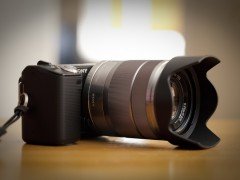
The independence to change lenses based on your needs gives a lot of freedom to a photographer. But what are these different types of lenses. Various lenses are suited for specific application. Lets have a look at some common names and what they do.
-
Normal/ Standard Lenses
These are lenses are provided by the camera manufacturers along with the camera as a part of the kit. These are generally of the 18 – 55mm focal length for a normal 35mm camera.
-
Telephoto Lenses
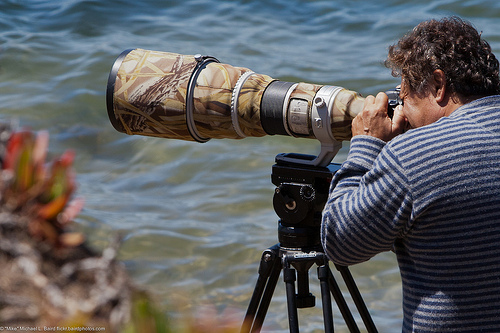
These are the lenses with focal length longer than the standard lens. Also called as Long Focus Lens. These lenses are generally used to take photographs from a distance. Especially for nature and wildlife photographywhere you cannot get closer to the subject physically, these long lenses help you in filling the frame with the subject from a distance. Normally, 70 – 300mm lens is recommended for such purpose though different combinations can be used based on your requirement.
-
Mirror Lenses
This is a special design of a long focus lens in which some of the lens elements are replaced with the mirrors. These lenses are generally lighter than the normal lens of the same focal length but they come with fixed aperture.
-
Wide Angle Lenses
These lenses have lower focal length than the standard lenses which helps in getting more area of view in the frame from the same distance. Typically used for taking landscape photographs, these lenses can increase the perspective distortion. So, caution is recommended.
-
Zoom Lenses
Zoom lenses are the lenses with variable focal lengths. In these lenses the positive and negative elements of the lens are put together in such a way that by moving them you can get varied focal lengths. You can also find telephoto lens with zoom lens capabilities. Do not get confused between the two.
-
Prime Lenses
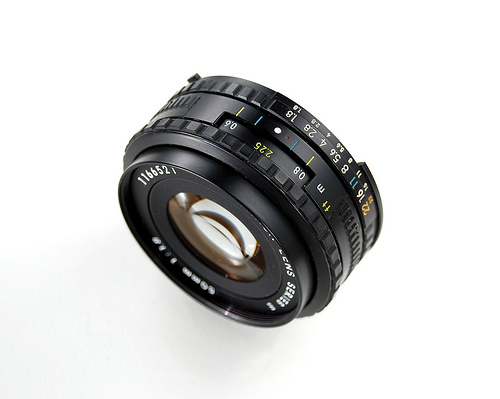
As opposed to zoom lenses, prime lenses have fixed focal length. (More about prime lens vs zoom lens here). These lenses generally have lesser moving parts as compared to zoom lenses and thus reduce the problems like chromatic aberrations. Prime lenses are also referred to as the fast lenses. These lenses generally have larger apertures which allow you to photograph in lower light and create wonderful bokeh effect.
-
Macro Lenses
These lenses are designed to do close up photography like flowers, insects, etc. Basically the macro lenses have very high focusing movement than the normal lenses.
-
Aspherical And Fluorite Lenses
Fluorite lens uses one or more elements of calcium fluoride (CaF 2 ) made from synthetic crystals. This lens has a very high color correction. Aspherical lens elements help to compensate for distortion in wide-angle lenses, and compensate or eliminate spherical aberrations in lenses with a large maximum aperture. They also allow manufacturers to produce more compact lenses than was previously possible using only spherical lens elements. These are costly lenses.
Planning to buy a lens? Check out the lens buying guide here.



Thomas January 28, 2009 at 4:33 pm
Really enjoy your post. Keep up the good work. Iike that most a only one page
and easy to print…..
zoom pic January 26, 2010 at 4:02 am
Great post, thank you for sharing. Cameras are really fun to have aside from viewing memories on the computer on on printed papers, the act of taking a picture is very fulfilling.
proform coupons June 1, 2010 at 9:33 am
Ive got a question for you. how does a fish eye lense work? I have always been curious about that
led lamps June 19, 2010 at 12:36 pm
Ah I was talking to a friend just the other day about our photography hobbies and we both had different ideas of what the best lenses were for everyday photography. I think I will link him up to this article. @ proform coupons… I think the fish eye lense is curved and this is what gives that effect. Someone correct me if I’m wrong?
BUCHANANCheryl July 17, 2010 at 12:10 pm
Different people all over the world take the business loans from various banks, because that is simple and comfortable.
karen@myrtle beach wedding photography August 19, 2010 at 3:40 am
Thanks for heads up. I’m not a professional photographer, I’m still working on my photos to get the best output. Now I know what type of lens to use based on my subject. I will surely recommend this to other photographers for added information.
Rae Merrill November 9, 2010 at 4:11 pm
You can’t beat a standard lens. I like to reverse mine with a reversing ring for macro shots. Produces very sharp results. I also like to do portraits wide open at 1.7 for shallow depth of field and soft resolution. I guess we all have our preferences and I do have some nice zooms as well.
harsath kalki August 13, 2011 at 3:37 pm
did you know about right angle spy lens
Shivanand Sharma August 13, 2011 at 6:11 pm
Yes. I bought one. Never seen a poorer photo quality.
Dallas Product Photographer August 19, 2011 at 10:00 pm
Aside from lenses, there are tons of filter, extension tubes, and other lens accessories.
All come in handy depending on what you are going for. You can get away with all kinds of accessories that are almost as good as an expensive macro lens.
ravi November 12, 2011 at 8:04 pm
What is the lens to be used for very shallow depth of field? I have a 14 -42 mm on my lumix g2 and not able to blur out background images? What lenses should I be using?
Shivanand Sharma November 12, 2011 at 8:29 pm
Anything above 85mm and an aperture of f-3.5 or wider should give you shallow DOF.
Rae Merrill November 12, 2011 at 11:04 pm
your lens is only 5.6 at the long end, about 65mm (35mm equivalent). so you wont get much shallow focus effect. you need to invest in one of the longer zooms for that camera. or a prime lens of 85mm (35mm equivalent) or above. i find 135mm is great for defocus effects.
phida hussain November 25, 2011 at 3:05 pm
what about prime lenses
shahzad ashiq January 1, 2012 at 11:29 pm
it’s not the correct info,,for which i am looking for….
:/
shahzad ashiq January 1, 2012 at 11:54 pm
where is fish eye lens?
Sherry April 7, 2012 at 1:50 am
What’s the main difference between a prime lens and a macro lens?
Rae Merrill April 9, 2012 at 3:09 pm
A prime lens refers to a lens of single focal length ie a 50mm lens or 100mm lens which doesn’t zoom. Macro lenses such as a 50mm Macro or 100mm Macro are both prime lenses.
farzeenahameed May 7, 2013 at 7:00 pm
what is the main diffrenence between a prime lens and macro lens